When buyers see yellow ash after burning Vietnamese sawdust charcoal, one of the first questions they often ask is:
“Does the yellow ash mean that additives or chemicals have been added to the charcoal?”
The short answer is not necessarily.
In many cases, the color of the ash is mainly related to the type of wood used to produce the charcoal, rather than the use of a chemical binder.
Vietnam has a large and diverse wood-processing industry, and sawdust from different wood species is available for charcoal production. As a result, Vietnamese sawdust charcoal can produce different ash colors, from bright white to light yellow or darker shades.
Here is what you should know before judging the quality of Vietnamese sawdust charcoal by its ash color.
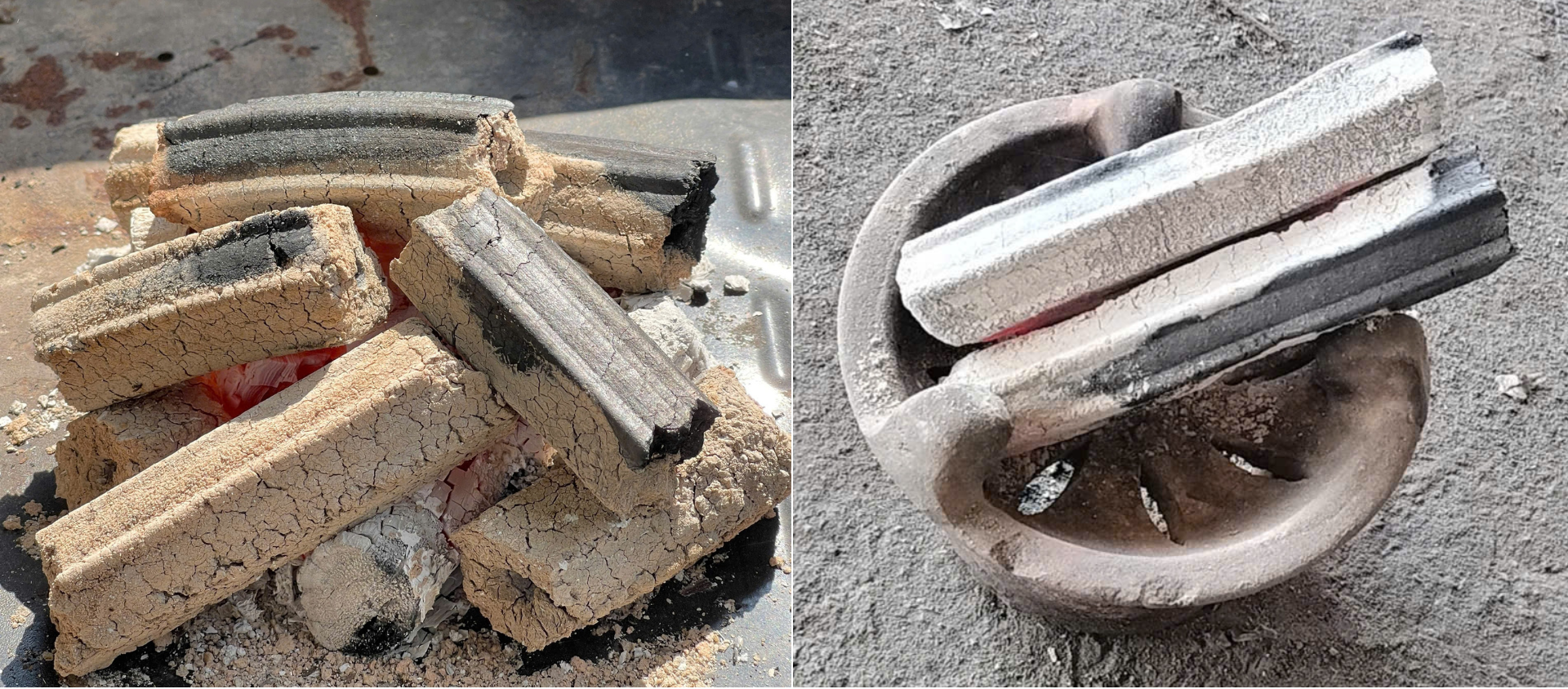
1. Are additives used to make sawdust charcoal?
This is one of the most common misunderstandings about sawdust charcoal.
To produce sawdust charcoal briquettes, manufacturers first compress sawdust into dense cylindrical or hexagonal briquettes. The compression process relies on high pressure, controlled moisture and the natural binding properties of wood, particularly lignin.
Lignin is a natural component of wood. Under suitable pressure and temperature conditions, it softens and helps the wood particles bond together.
Therefore, properly produced sawdust briquettes can be manufactured without adding an external chemical binder. Research on biomass briquetting also shows that fine, lignin-rich woody materials such as sawdust have relatively low binder demand, while suitable pressure, moisture and particle size can allow densification with little or no added binder.
This is an important distinction:
A sawdust briquette does not need to contain an artificial adhesive simply because it has been compressed into a solid shape.
After the briquette is formed, it can be carbonized in a controlled kiln to produce sawdust charcoal.
However, buyers should still ask the supplier about the actual production process. Different factories may use different technologies, and not every biomass briquetting process is identical.
2. So where does the yellow ash come from?
The answer is often much simpler than people think:
It can come from the wood itself.
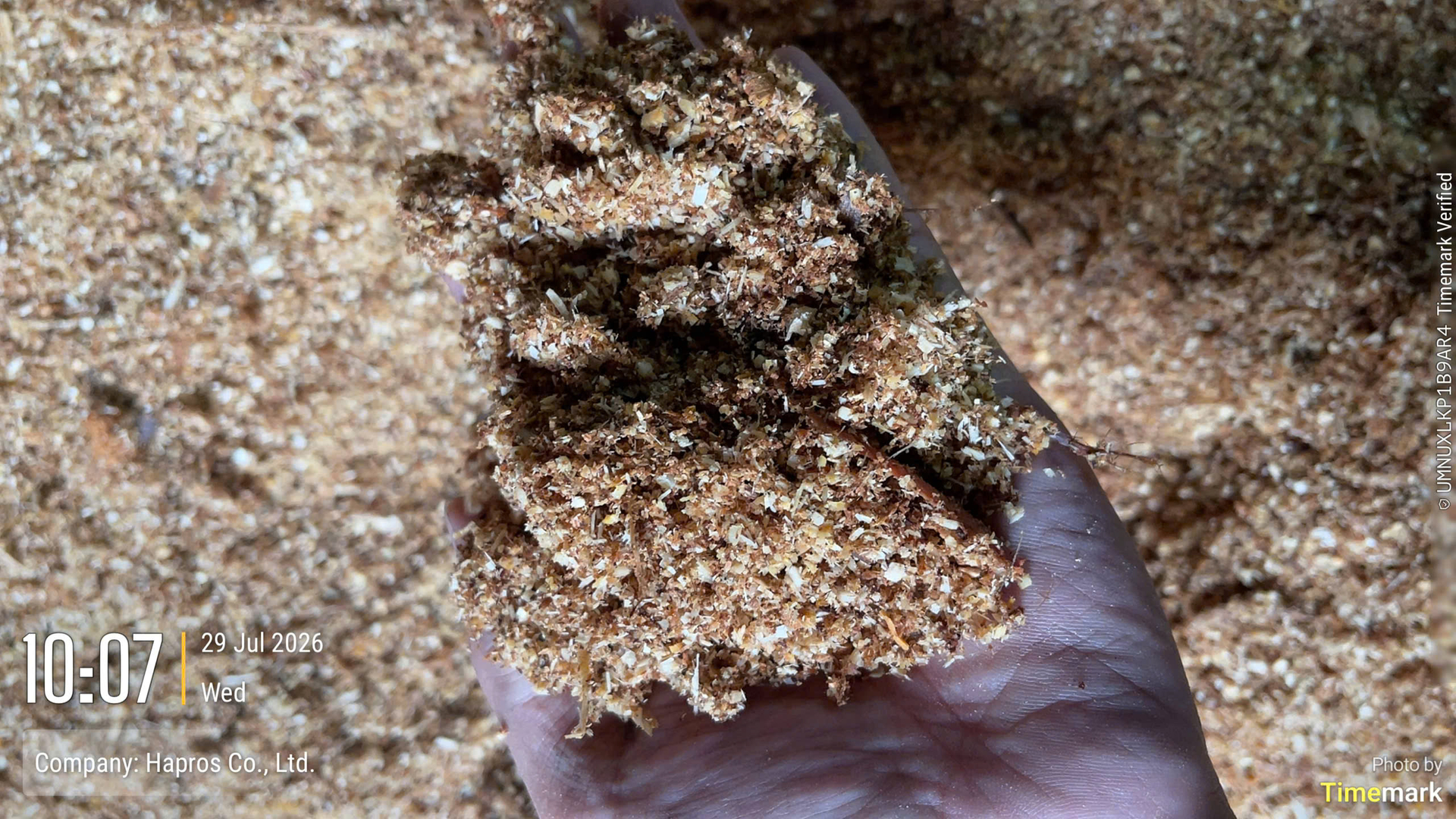
Different wood species contain different amounts and compositions of naturally occurring minerals. When wood is burned, the organic components are largely converted into gases and heat, while inorganic minerals remain in the ash.
Because the mineral composition varies between species and even between growing conditions, ash from different woods can have different colors and appearances.
For example, in practical charcoal production, some hardwood feedstocks can produce relatively bright or whitish ash, while other species can produce ash with a yellow, beige, gray or darker appearance.
This means:
Yellow ash does not automatically mean that chemicals have been added.
The wood species and the mineral composition of the raw material can play an important role.
It is also important to understand that ash color is not a universal fingerprint for one particular wood species. The same species can produce somewhat different ash depending on factors such as the part of the tree used, growing conditions, bark contamination, soil minerals and carbonization/combustion conditions.
3. Why is yellow ash relatively common in some Vietnamese sawdust charcoal?
One important reason is acacia.
Acacia has become one of the most widely planted commercial tree species in Vietnam. Vietnam has developed a large acacia plantation sector, with acacia being used for woodchips, timber, furniture and other wood-processing applications. One industry project reported that acacia accounted for around 60% of Vietnam's plantation area at the time of the study.
Acacia is also widely used in Vietnam's wood-processing value chain. Studies of Vietnamese acacia value chains show that plantation acacia is processed for woodchips, sawn timber and furniture production.
Wood processing naturally creates large quantities of sawdust and other wood residues.
Instead of treating this material simply as waste, part of it can be used to produce:
Wood pellets
Compressed wood products
Biomass briquettes
Sawdust charcoal
When acacia sawdust is used as the raw material for charcoal, the resulting ash can have a yellowish or beige appearance.
Therefore, if you burn a Vietnamese sawdust charcoal made primarily from acacia sawdust and notice yellowish ash, this does not by itself prove that the manufacturer has added chemicals.
It may simply reflect the characteristics of the raw material.
Learn more: Premium Hardwood Sawdust Charcoal vs Acacia Sawdust Charcoal
4. Does all Vietnamese sawdust charcoal produce yellow ash?
No.
This is an important point for international buyers.
Vietnam does not have only one type of sawdust.
Charcoal factories can source sawdust from different wood-processing industries. Depending on the region and supplier, the raw material may include sawdust from species such as:
Acacia
Longan
Lychee
Ash
Oak
Cinnamon
Mahogany
Other hardwood species
Therefore, Vietnamese sawdust charcoal can produce different ash colors.
For example, charcoal made from selected hardwood sawdust may produce brighter white or light-gray ash, while charcoal made from acacia sawdust may produce a more yellowish or beige ash.
This is why buyers should not judge the entire Vietnamese charcoal industry based on the ash color of one particular product.
The more important question is:
What type of sawdust was used to make the charcoal?
And, more importantly:
Does the charcoal meet the required performance specifications?
learn more: Types of Sawdust Charcoal in Vietnam You Should Know
5. Is acacia sawdust charcoal lower quality?
Not necessarily.
This is another common misconception.
The species of wood used as raw material can influence ash color, but ash color alone does not determine charcoal quality.
A properly manufactured acacia sawdust charcoal can achieve strong performance in terms of:
Burning time
Fixed carbon
Calorific value
Density
Ignition characteristics
Smoke and odor
Ash content
Mechanical strength
For example, depending on the production process and specification, a commercial-grade acacia sawdust charcoal can be manufactured to achieve a burning time of more than 6 hours, a calorific value above 7,200 kcal/kg, and fixed carbon above 80%.
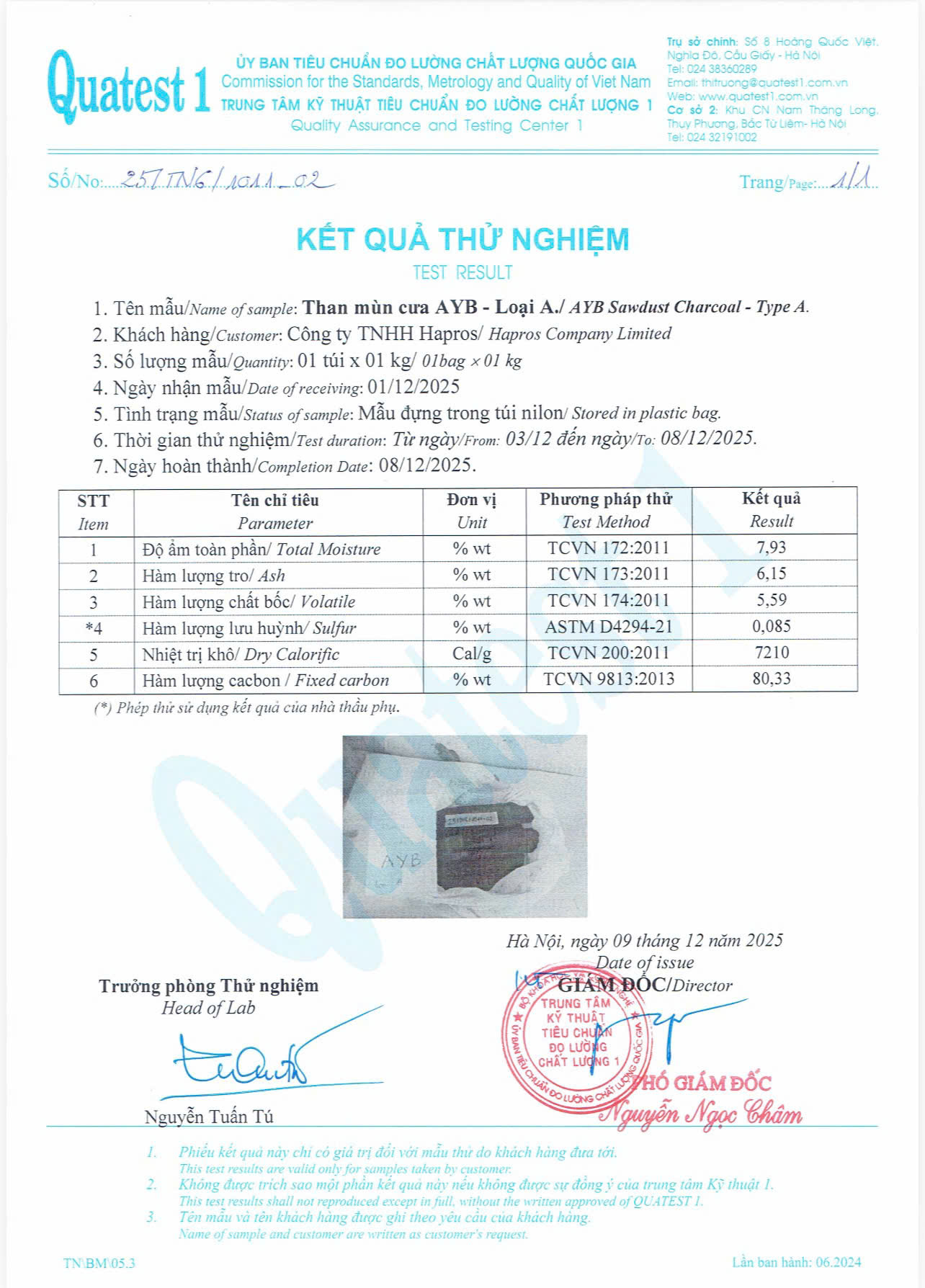
These figures should be understood as quality targets/specifications for a properly controlled product, rather than properties automatically guaranteed by the word “acacia.”
The production process matters greatly.
Raw material selection, drying, briquette density, carbonization temperature, carbonization time and final sorting can all affect the final quality.
So the correct way to compare two charcoal products is not simply:
White ash = good
Yellow ash = bad
A more meaningful comparison is:
What is the raw material, and what are the actual performance specifications of the finished charcoal?
6. Should you buy acacia sawdust charcoal?
There is no universal answer.
It depends on your customers, your market and your product strategy.
If your customers mainly care about:
Stable burning performance
Competitive pricing
Sustainable use of wood-processing residues
Consistent quality
Good heat output
then acacia sawdust charcoal can be an attractive option.
Acacia charcoal also has an interesting sustainability story.
Instead of allowing sawdust from the wood-processing industry to become an underutilized residue, it can be converted into a useful fuel product.
This makes the product potentially attractive to customers who place importance on resource efficiency, waste utilization and responsible use of plantation-grown wood.
Another advantage is price.
Because acacia is widely planted and its wood-processing value chain generates significant quantities of residues, acacia sawdust can be more readily available than some premium hardwood feedstocks. This can help manufacturers offer a more competitive price.
However, there is one important consideration.
What if your customers specifically require white ash?
If your market strongly prefers bright white ash, you should not immediately switch to large-volume purchases of acacia charcoal simply because the price is attractive.
Consumer preferences are important.
In some markets, customers associate white ash with premium charcoal quality. Even if the yellow ash is completely natural and the charcoal performs well, changing consumer expectations can take time.
In this situation, it may be better to:
Test the product with a small quantity.
Let customers evaluate the actual burning performance.
Compare ash color, burning time and heat output.
Collect feedback from end users.
Decide whether acacia charcoal should become part of your product portfolio.
Learn more: Should You Buy Vietnam Sawdust Charcoal Directly from a Factory?
Final Thoughts: Yellow Ash Does Not Tell the Whole Story
The color of charcoal ash is one of the easiest things to see, but it is not enough to determine charcoal quality.
Yellowish ash can be a natural characteristic of charcoal made from certain types of wood, including acacia-based sawdust.
Vietnam's large acacia plantation and wood-processing industries provide a significant supply of sawdust and other wood residues that can be converted into useful biomass products and charcoal.
So when evaluating Vietnamese sawdust charcoal, don't ask only:
“Is the ash white?”
Also ask:
What wood was used?
Was any binder added?
What is the fixed carbon content?
What is the calorific value?
How long does it burn?
What is the ash content?
Is the quality consistent from batch to batch?
A yellowish ash does not automatically mean poor quality.
In many cases, it simply tells you something about the wood that was used to make the charcoal.
And for buyers looking for a balance between performance, price and responsible utilization of wood-processing residues, acacia sawdust charcoal can be a product worth considering.